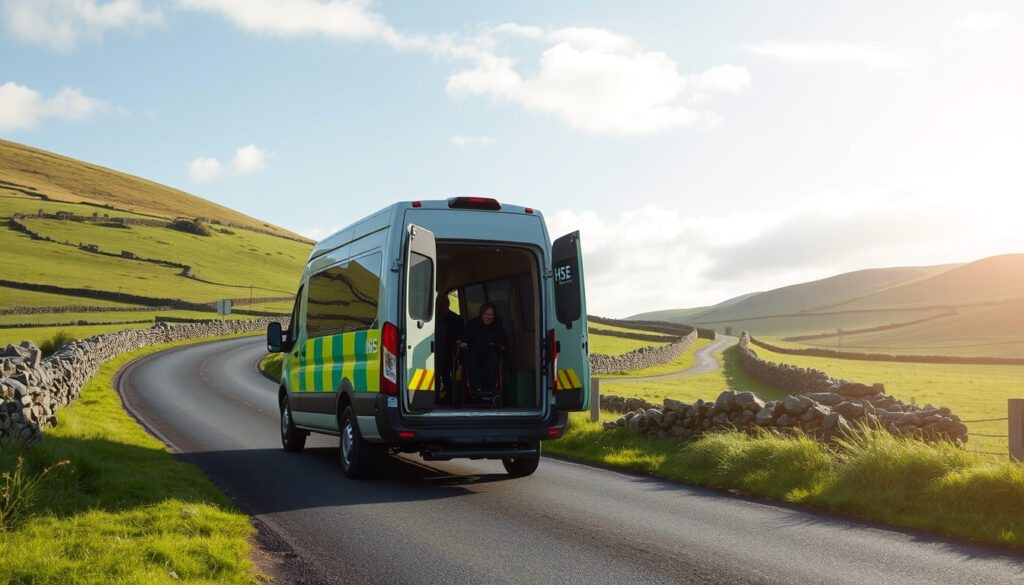
Non-Emergency Medical Transportation Ireland: HSE Guide
Getting to a hospital appointment sounds simple until you live more than an hour from the nearest specialist clinic. Ireland’s Health Service Executive moves thousands of patients each year through a patchwork of taxis, contracted ambulances, and volunteer drivers — spending that has more than doubled since 2020. If you or someone you care for needs transport to a day hospital, outpatient clinic, or chemotherapy session, the system has real options, but the rules and costs are not always obvious.
Primary Provider: HSE Patient Transport Services · Key Eligibility: Hospital appointments and outpatient services · Commercial Options: Medicare Ambulance, Medilink · Official Info Source: Citizens Information · NI Contact Number: 028 7134 7134
Quick snapshot
- HSE spent €27m on taxis in 2020 and €29m in 2021 (Medical Independent)
- National hospital taxi costs rose from €39.5m in 2021 to €61m in 2025 (Irish Times)
- Beaumont Hospital spent €5,226,094 on taxis in 2025 alone (Irish Times)
- Exact patient eligibility thresholds for free HSE transport
- Current 2026 national spending figures
- Individual trip reimbursement rates not publicly published
- HSE private ambulance spend doubled from €4.3m (2014) to €8.1m (2017) (Irish Examiner)
- Hospital taxi costs jumped 54% in four years (2021–2025) (Irish Times)
- Cork taxi spend reached €2.383m in 2024 (EchoLive)
- New Irish Cancer Society radiotherapy transport pilots in Cork (Irish Cancer Society)
- Ongoing political debate about HSE fleet vs contractor model (Irish Cancer Society)
- Growing pressure on HSE to publish transparent eligibility criteria (Irish Cancer Society)
| Category | Detail |
|---|---|
| Main Public Service | HSE Community Care Transport |
| Commercial Leader | Medicare Ambulance |
| Eligibility Focus | Hospital appointments, clinics |
| Info Hub | CitizensInformation.ie |
| Cork 2024 Taxi Spend | €2.383m (EchoLive) |
| National 2025 Taxi Spend | €61m (Irish Times) |
| Single Hospital Record | Beaumont €5,226,094 in 2025 (Irish Times) |
| Cappagh 2023–2025 | €0 (Irish Times) |
Does HSE provide transport to hospital appointments?
Yes. The Health Service Executive operates a Community Care Transport service designed to carry outpatients, day-hospital patients, and those attending renal dialysis to and from HSE facilities. This falls under its statutory responsibility for non-emergency patient transport, a role confirmed as far back as a 2010 Citizens Information Board report.
Eligibility for HSE transport
Eligibility is not uniform across Ireland. Patients must typically have a medical need that prevents them using public transport, and the service is means-tested. People attending day hospitals, outpatient departments, and renal dialysis units are the core users. A HSE South West spokesperson told local media that taxis are used for non-acute patients and inter-facility transfers, including patient files and charts between hospitals.
How to apply for HSE patient transport
Contact your local HSE Community Care office directly. Patients usually need a referral from their hospital consultant or GP confirming medical need. The HSE gives priority to emergency work, so routine outpatient trips are handled through contracted providers — taxis, minibuses, and private ambulance services. This contracting model means the HSE avoids owning and maintaining its own fleet, which officials argue is more cost-effective given staffing, fuel, and insurance overheads.
How much does an ambulance ride cost in Ireland?
This is where the picture gets complicated — and expensive. Ireland’s public ambulance (dial 999 or 112) is free at the point of use for genuine emergencies. Non-emergency transport is a different matter, with costs varying sharply depending on who provides the service and whether the HSE or a private insurer covers it.
Costs for non-emergency vs emergency
Emergency ambulances are funded through the National Ambulance Service and cost patients nothing upfront. Private ambulance providers, contracted by the HSE for less urgent patient cases, set their own rates. According to Irish Examiner analysis, HSE private ambulance spending grew from €4.3m in 2014 to €8.1m in 2017 — almost doubling in three years. The Irish Times reported that national hospital taxi costs reached €61m in 2025, up from €39.5m in 2021.
Regional disparities are stark. The north-west and mid-west regions spent €7.3m per year on taxis during 2020–2021, while the northern area covering north Dublin hospitals spent just €700k in total over those two years. Beaumont Hospital in Dublin alone spent €5,226,094 on taxis in 2025, according to figures reported in the Irish Times.
Private ambulance pricing
Private operators like Medicare Ambulance in Cork provide transport for mobile patients, wheelchair users, and stretcher cases. Pricing depends on distance, vehicle type, and whether the trip is covered by the HSE, private health insurance, or paid out-of-pocket. Trasna Healthcare, which handles some HSE reimbursement processes, advises patients on transport costs per procedure on its website.
Ireland’s non-emergency transport costs have climbed 54% in four years — from €39.5m nationally in 2021 to €61m in 2025 — without a published policy framework setting out when taxis are appropriate versus dedicated patient transport vehicles.
Do you need to pay if you call an ambulance?
For a genuine medical emergency, the answer is straightforward: no. The Irish public ambulance service is free at the point of use. However, the definition of “emergency” matters enormously, and what happens after the trip — invoicing, reimbursement, or out-of-pocket payment — depends on thecircumstances.
Payment rules for HSE ambulances
When the National Ambulance Service dispatches an emergency response to a 999 or 112 call, patients do not receive an invoice. HSE officials have stated that HSE vehicles are prioritized for emergency work, and the service is funded through the public health system. Dialysis patients, who may need transport three times weekly, represent one of the largest cost centres in the HSE’s non-emergency transport budget.
Non-emergency transport fees
Non-emergency trips arranged through the HSE for outpatients or inter-facility transfers may be free for eligible patients but require an eligibility check. Patients who do not qualify must pay privately. The HSE’s own staff travel allowance rates provide a reference point: day rates of €19.25 for 5–10 hours and €46.17 for trips exceeding 10 hours, with an overnight rate of €205.53, according to the HSE’s official travel allowances page.
HSE vehicles are reserved for emergency calls. Non-emergency patient transport relies almost entirely on contracted taxis, private ambulances, and volunteer services — each with different payment structures and eligibility rules. Patients unfamiliar with these distinctions can face unexpected bills.
How to organise transport to and from hospital?
Organising non-emergency transport in Ireland involves knowing which service covers your situation, how to qualify for free or subsidised transport, and what alternatives exist if you do not meet HSE eligibility criteria.
Steps for HSE patient transport
The process typically begins with a referral. A hospital consultant, GP, or dialysis nurse assesses whether a patient has a medical need that prevents using public transport. If approved, the local HSE Community Care office arranges a contracted provider. The HSE does not maintain a unified national booking platform; arrangements are made locally, which explains the significant regional variation in spending and service availability.
For cancer patients specifically, the Irish Cancer Society operates free volunteer-led transport to chemotherapy at partner hospitals across Ireland, including a radiotherapy pilot at University Hospital Cork and Bons Secours Cork. The Travel2Care fund also provides financial assistance for cancer patients travelling more than 50km one way to treatment centres.
Private service booking process
Private providers such as Medicare Ambulance accept direct bookings from patients who do not qualify for HSE-funded transport. Medicare Ambulance’s website confirms it provides transport for mobile patients, wheelchair users, and stretcher cases in the Cork area. Patients should confirm whether their health insurer covers non-emergency ambulance transport before booking — some policies include partial coverage.
Medicare Ambulance provides transport for mobile, wheelchair, and stretcher patients in the Cork area, accepting both HSE-funded and privately booked trips.
What is the non-emergency ambulance number in Ireland?
Ireland’s emergency number (999 or 112) connects callers to the National Ambulance Service for life-threatening situations. There is no single national non-emergency transport booking line equivalent, but patients can contact the HSE through several channels depending on their region and transport need.
HSE transport phone contacts
HSE Community Care Transport is accessed through local HSE offices rather than a central call centre. Patients should contact their nearest HSE Community Healthcare Organisation office to enquire about eligibility and arrange transport. The Citizens Information website (CitizensInformation.ie) serves as the official information hub for public health services including patient transport eligibility.
For patients in Northern Ireland requiring cross-border non-emergency transport to Republic of Ireland hospitals, the contact number is 028 7134 7134. This covers arrangements for patients attending HSE facilities from the Northern Ireland border region.
Regional dispatch numbers
Unlike the unified 999 system for emergencies, non-emergency patient transport dispatch varies by HSE region. Patients should contact their local HSE Community Care office directly — contact details are available through the HSE website. The HSE’s own travel allowances page (healthservice.hse.ie) provides official policy guidance and is a key reference for both patients and healthcare staff arranging transport.
Ireland has no published national eligibility framework for non-emergency patient transport. Patients in rural areas with genuine medical need may face confusing variation between regions, and some who qualify under one HSE area’s rules may not qualify in another.
How to book non-emergency transport step by step
For patients with a confirmed medical need, here is the practical path to organising HSE-funded or subsidised transport:
- Get a referral. Ask your hospital consultant, GP, or dialysis nurse to confirm in writing that you cannot use public transport due to your medical condition.
- Contact your local HSE Community Care office. Find your regional HSE Community Healthcare Organisation on the HSE website and call their transport enquiry line.
- Confirm eligibility. The HSE will assess your medical need and financial situation. Be ready to provide your medical card or GP details.
- Book through the contracted provider. If approved, the HSE arranges transport through its contracted taxi firms, private ambulances, or minibus services — you do not choose the provider.
- If ineligible, explore alternatives. Contact the Irish Cancer Society (if applicable), your private health insurer, or a private provider like Medicare Ambulance for direct booking.
- Keep records. Save all booking confirmations and any invoices — these are needed if you seek reimbursement through Trasna Healthcare or your insurer later.
Confirmed vs unclear
Confirmed
- HSE provides transport to outpatient services and day hospitals
- Hospital taxi costs rose from €39.5m (2021) to €61m (2025)
- Beaumont Hospital spent €5,226,094 on taxis in 2025
- Irish Cancer Society offers free cancer patient transport
- Private ambulance providers operate alongside HSE contracts
Unclear
- Exact national eligibility thresholds not publicly published
- No published policy on when taxis are preferred over dedicated vehicles
- Individual trip reimbursement rates unavailable
- 2026 spending figures not yet released
“Using taxis for patient transport remains a more cost-effective solution compared to the cost involved in investing in a fleet of HSE-owned vehicles.”
— HSE South West spokesperson (EchoLive)
“There is no question that money would be saved if the HSE switched to an in-house service with dedicated drivers.”
— TD Buckley, politician (EchoLive)
The Irish health system relies heavily on contracted taxis and private ambulance firms to move non-emergency patients, a model that has drawn criticism from politicians while being defended by HSE officials as more economical than owning a fleet. The numbers tell a story of rapid growth: national hospital taxi spending hit €61m in 2025, up 54% from €39.5m in 2021. Beaumont Hospital alone spent over €5m on taxis that year. For patients, the practical challenge is not the existence of transport options but understanding who qualifies for free HSE transport, which regions have adequate coverage, and what alternatives exist when they do not meet the criteria.
How to get home help from HSE?
Home help and home care packages are administered through HSE Community Care. Contact your local HSE Community Healthcare Organisation office to apply. Eligibility is based on assessed care needs, not transport-related services.
What qualifies as an emergency?
A medical emergency typically involves a life-threatening condition requiring immediate response — heart attack, stroke, major trauma, severe bleeding. Call 999 or 112. Non-emergency situations include outpatient appointments, dialysis sessions, and routine transfers between hospitals.
Where can I get immediate assistance?
For emergencies, call 999 or 112 — this reaches the National Ambulance Service. For non-emergency medical transport enquiries, contact your HSE Community Healthcare Organisation office or visit CitizensInformation.ie for official guidance.
Related reading: Stage 1 Melanoma Mole · What Causes Kidney Stones
HSE’s NEMT options in Ireland align closely with broader practices outlined in this NEMT eligibility guide, aiding patients in assessing eligibility criteria.
Frequently asked questions
Does HSE cover transport for all hospital appointments?
No. HSE Community Care Transport covers patients with a medical need who cannot use public transport. Eligibility is means-tested and requires a referral from your healthcare provider. Not all outpatients qualify.
How much does a private ambulance cost in Ireland?
Private ambulance rates are not standardised. Providers like Medicare Ambulance set their own pricing based on distance, vehicle type, and patient needs. Without HSE funding or insurance coverage, patients pay out-of-pocket.
Is there a free transport option for cancer patients?
Yes. The Irish Cancer Society provides free volunteer-led transport to chemotherapy at partner hospitals. The Travel2Care fund assists patients travelling more than 50km one way to treatment centres. Both are free to eligible patients.
What is the phone number for HSE non-emergency transport?
There is no single national booking line. Contact your local HSE Community Healthcare Organisation office directly — details are on the HSE website. For cross-border transport from Northern Ireland, call 028 7134 7134.
Can I claim back transport costs from the HSE?
Patients who qualify for HSE-funded transport do not pay upfront. Those who pay privately may claim reimbursement through Trasna Healthcare or their health insurer, depending on their policy. Exact per-trip reimbursement rates are not publicly published.
More related posts
 100 Grams to Cups – Accurate Baking Conversion Chart
 Привітання з Днем Народження – Ukrainian Wishes Guide
 What Is a Nonce in Security – Definition, Examples and Uses
 Spider-Man: Into the Spider-Verse – Plot, Cast, Awards and Sequel
 Cast of Midnight Mass: Actors and Roles (2021 Netflix)
 All Inclusive Resorts Mexico – Complete 2025 Guide
 Current Mortgage Rates Alberta – Lowest Broker Fixed and Variable Rates
 Best Travel Credit Card – Top 2025 Picks Compared
