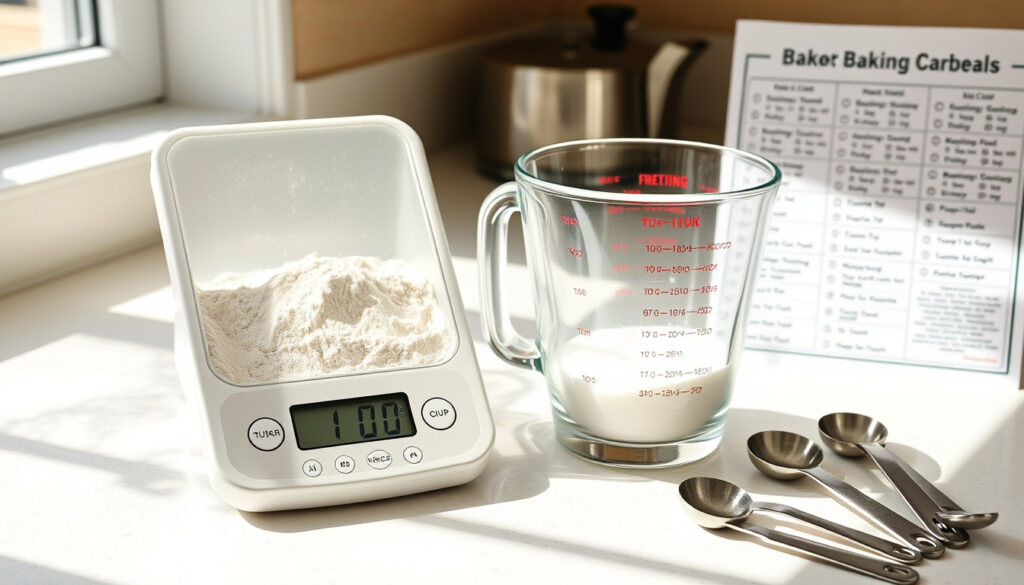
100 Grams to Cups – Accurate Baking Conversion Chart
Converting 100 grams to cups requires understanding that grams measure weight while cups measure volume. This fundamental difference means the conversion depends entirely on the ingredient’s density. Whether you are baking a cake or preparing a sauce, knowing how to navigate this conversion accurately can determine the success of your recipe.
The metric system and the imperial system approach measurements differently, which creates confusion for home cooks and professional bakers alike. A kitchen scale measuring in grams provides the most reliable results, but when only measuring cups are available, understanding these conversions becomes essential. This guide covers the most common baking ingredients and explains why density plays such a crucial role in achieving accurate measurements.
How Many Cups Is 100 Grams?
The answer varies significantly depending on what you are measuring. One hundred grams of all-purpose flour equals approximately 0.8 cups, while the same amount of granulated sugar measures about 0.5 cups. Water, butter, and other ingredients each have their own conversion rates based on their physical properties.
For common baking ingredients, 100 grams converts to roughly 4/5 cup for flour, 1/2 cup for granulated sugar, and about 2/5 cup for butter. These approximations work well for most home baking purposes.
Key Conversion Insights
- Grams measure weight, while cups measure volume—this distinction affects every conversion
- Ingredient density determines how much volume 100 grams occupies
- Dense ingredients like honey weigh more per cup than lightweight ingredients like flour
- Using a digital kitchen scale eliminates measurement inconsistencies
- US cups (240 ml) differ slightly from metric cups (250 ml)
- Packing method affects results for powders and granular ingredients
- Professional bakers prefer weighing ingredients over volume measurements
100 Grams Conversion Snapshot
| Ingredient | Density (g per cup) | 100g Equals |
|---|---|---|
| All-purpose flour | 120g | 0.83 cups |
| Bread flour | 127g | 0.79 cups |
| Cake flour | 114g | 0.88 cups |
| Granulated sugar | 200g | 0.50 cups |
| Brown sugar (packed) | 195g | 0.51 cups |
| Powdered sugar | 120g | 0.83 cups |
| Butter | 227g | 0.44 cups |
| Water | 240g | 0.42 cups |
These values represent averages from established baking resources. Variations exist between brands and measurement techniques, which is why professional sources sometimes report slightly different figures. King Arthur Baking’s ingredient weight chart provides detailed measurements for various flours and sweeteners.
100 Grams of Flour to Cups
Flour conversions require particular attention because flour types vary significantly in density. A cup of all-purpose flour does not weigh the same as a cup of bread flour or cake flour, which means 100 grams of each produces different volume measurements.
All-Purpose Flour
One hundred grams of all-purpose flour equals approximately 0.8 cups or 4/5 of a cup. However, this conversion assumes the flour was spooned into the measuring cup and leveled without packing. King Arthur Baking specifies 120 grams per cup for all-purpose flour measured this way.
Different sources report slightly varying results. Some indicate 100 grams equals 2/3 cup, while others state 0.8 cups. These differences stem from variations in flour brands, humidity levels, and measurement techniques.
Sifted vs. Unsifted Flour
Sifting flour introduces air and reduces its density, meaning sifted flour weighs less per cup than unsifted flour. One hundred grams of sifted flour occupies more volume than the same weight of packed flour.
For consistent baking results, spoon flour into your measuring cup until it mounds slightly above the rim, then level with a straight edge. Avoid scooping directly from the bag, as this compacts the flour and results in using more than the recipe intends.
Other Flour Types
Whole wheat flour and rye flour have different densities than all-purpose flour due to their higher fiber content. A cup of rye flour weighs approximately 102 grams, while semolina flour weighs around 167 grams per cup, according to cuisinefiend.com.
100 Grams of Sugar to Cups
Sugar conversions also depend on crystal size and packing method. Granulated white sugar converts differently than brown sugar or powdered sugar, even when measured by weight.
Granulated Sugar
One hundred grams of granulated or caster sugar equals exactly 0.5 cups or one-half cup. This is one of the more straightforward conversions because granulated sugar has a consistent density. For larger quantities, 200 grams converts to approximately 1 cup of granulated sugar.
Powdered Sugar
Powdered sugar, also known as confectioners’ sugar, is denser than granulated sugar when measured by volume. One hundred grams of powdered sugar equals approximately 0.83 cups or 4/5 cup. This higher density occurs because the fine crystals pack more tightly together. Two hundred grams converts to roughly 1.65 cups.
Brown sugar should always be packed into the measuring cup for accurate results. When packed, 100 grams equals approximately 0.51 cups. The molasses content in brown sugar contributes to its slightly different density compared to white sugar.
100 Grams Water, Butter, and Other Ingredients to Cups
Beyond dry ingredients, understanding liquid and fat conversions helps complete a comprehensive approach to gram-to-cup conversions in the kitchen.
Liquids Like Water
Water provides a unique reference point because its density is well established. Water maintains a 1:1 ratio between grams and milliliters, meaning 240 ml of water weighs exactly 240 grams. One US cup contains 240 ml, so 100 grams of water equals approximately 0.42 cups.
This consistency makes water useful for understanding the general relationship between weight and volume, though other liquids may behave differently depending on their composition and sugar content.
Butter and Fats
One hundred grams of butter equals approximately 0.44 cups or 2/5 cup. This conversion is particularly useful for baking recipes that list butter in grams. For reference, 200 grams of butter converts to about 0.88 cups. Most butter sticks sold in the United States are marked with measurements, making gram conversions helpful for recipes using metric weights.
Rice and Dry Goods
Rice density varies by type and how it is measured. Long-grain rice weighs differently than short-grain rice, and conversions can be approximate. For recipes requiring precision, weighing rice rather than measuring by volume produces more consistent results.
Why Grams to Cups Conversions Vary
The variation in gram-to-cup conversions stems from fundamental physical properties and measurement practices that affect every ingredient differently.
Density and Packing
Density represents how much mass fits within a given volume. Honey, with a density around 1.4 grams per milliliter, weighs considerably more per cup than flour at approximately 0.5 grams per milliliter. The Calculator Site explains that different ingredients have dramatically different densities, which is why 100 grams of honey occupies far less volume than 100 grams of flour.
Packing density compounds this issue. When flour is scooped directly from a bag, it compresses, resulting in more flour per cup than the spoon-and-level method. This compression can add 15-20% more flour to a measurement, significantly affecting baking outcomes.
Measurement Tips for Accuracy
- Weigh ingredients using a digital kitchen scale for the most accurate results
- Use standardized measuring cups designed for dry or wet ingredients appropriately
- Level dry ingredients with a straight edge after filling the cup
- Pack brown sugar and similar ingredients consistently when the recipe requires it
- Consider room temperature, as ingredients like butter expand and contract with temperature changes
Converting between grams and cups inherently involves approximation. While these conversions work well for general cooking, precision baking often requires direct weight measurements. When accuracy matters most, prioritize using a scale over volume measurements.
Conversion Precision: What We Know and What Remains Unclear
| Established Information | Approximate or Variable |
|---|---|
| Water: 100g = 0.42 cups (exact density known) | Flour: 100g = 0.77–0.88 cups depending on type |
| Granulated sugar: 100g = 0.5 cups (consistent density) | Powdered sugar: measurements vary by sifting |
| Butter: 100g = 0.44 cups (based on standard density) | Rice and grains: density varies by type and age |
| US cup standardized at 240ml | Packaging differences between brands affect results |
Understanding Volume vs. Weight in Baking
Baking differs from cooking in its emphasis on precision. While soups and stews tolerate variation, baked goods often require exact ratios of ingredients to achieve proper texture and rise. This precision requirement explains why professional bakers favor weight measurements over volume.
The distinction between US customary cups and metric cups adds another layer. A US cup contains 240 milliliters, while a metric cup contains 250 milliliters. Most American recipes use US customary measurements, which is the standard referenced in this guide.
Recipes from different countries may use different cup sizes, making international recipe conversions particularly challenging. When following recipes from unfamiliar sources, verifying the measurement system used becomes important for achieving expected results.
Sources and Methodology
This guide draws from established baking resources and ingredient databases. King Arthur Baking’s ingredient weight chart provides standardized measurements based on extensive testing. The Calculator Site offers practical conversion tools for common baking ingredients.
Additional sources including cuisinefiend.com, Eat Little Bird, and Charlotte’s Lively Kitchen contributed comparative data for flour and sugar conversions.
These sources generally agree on core conversions but may report slightly different values reflecting variations in measurement techniques, ingredient brands, and regional standards. The ranges provided in this guide acknowledge these legitimate differences rather than presenting a single false precision.
Summary
Converting 100 grams to cups requires knowing the specific ingredient because density varies dramatically between flour, sugar, butter, water, and other common baking ingredients. For all-purpose flour, 100 grams equals approximately 0.8 cups, while granulated sugar converts to 0.5 cups and butter to 0.44 cups. Water, with its consistent density, converts to roughly 0.42 cups per 100 grams.
The variation between sources reflects genuine differences in measurement techniques and ingredient densities. For the most accurate results in baking, investing in a digital kitchen scale eliminates the guesswork inherent in volume measurements. While these gram-to-cup conversions provide practical guidance for everyday cooking, understanding the underlying principles helps achieve better results in the kitchen.
Frequently Asked Questions
Is 100 grams exactly equal to 1 cup?
No, 100 grams is not exactly 1 cup for any common ingredient. Only water approaches this ratio closely, and even then, 100 grams equals approximately 0.42 cups, not 1 cup.
How many cups is 100 grams of all-purpose flour?
One hundred grams of all-purpose flour equals approximately 0.8 cups or 4/5 cup when measured by spooning flour into the cup and leveling it.
What is the most accurate way to measure grams to cups?
Using a digital kitchen scale to weigh ingredients directly provides the most accurate results. Volume measurements like cups involve inherent approximation due to packing variations.
How many cups is 100 grams of butter?
One hundred grams of butter equals approximately 0.44 cups or about 2/5 cup, based on butter’s standard density of 227 grams per cup.
Does sifting flour change the gram-to-cup conversion?
Yes, sifting flour reduces its density by introducing air. Sifted flour occupies more volume per gram than unsifted flour, meaning 100 grams of sifted flour equals more than 100 grams of unsifted flour.
How many cups is 100 grams of water?
One hundred grams of water equals approximately 0.42 cups. Water has a density of 1 gram per milliliter, with 1 US cup containing 240 milliliters.
Why do different sources show different gram-to-cup conversions?
Differences arise from variations in measuring techniques, ingredient brands, moisture content, and whether measurements are sifted or packed. No single conversion applies universally across all sources.
What is 100 grams of powdered sugar in cups?
One hundred grams of powdered sugar equals approximately 0.83 cups or 4/5 cup. Powdered sugar is denser than granulated sugar due to its fine texture.
More related posts
 Luke Perry: Cause of Death, Relationships, and Estate Facts
 Shoppers Drug Mart Stratford: 3 Stores Compared
 Russell Brands: Biography, Career, Health, Religion & Family
 Tracy Morgan Crash & Recovery: Driver Plea & Health Update
 Chi Lewis-Parry: Nationality, Ethnicity, Height, Career & Movies
 How Long Does Implantation Bleeding Last? Duration & Signs
 Emma Stone: Anxiety, Relationships, and Career Facts
 Kendra Wilkinson: Divorce, Health Scares, and Life Now
