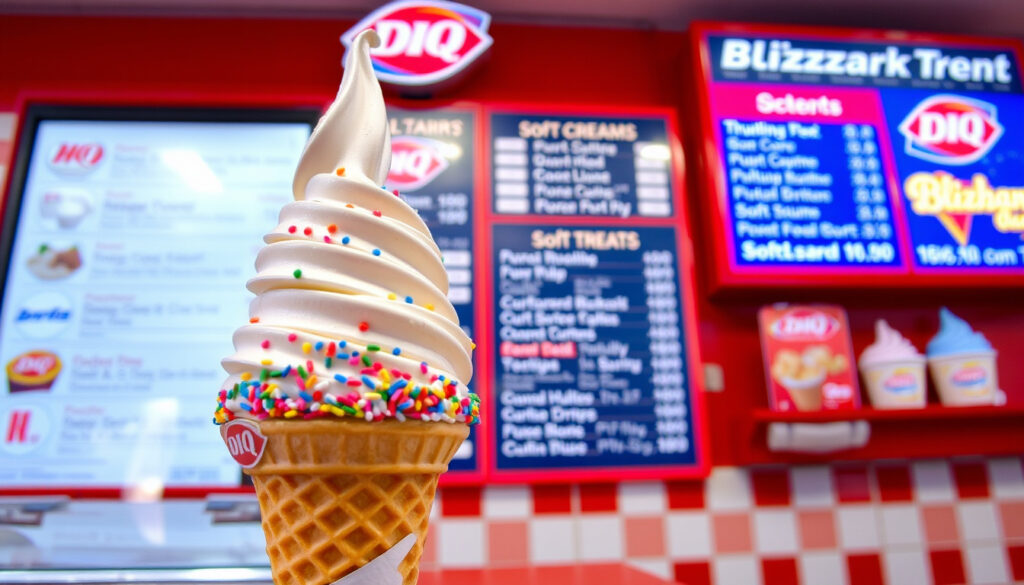
Dairy Queen Ice Cream: Real or Soft Serve? Menu Guide
Walk into any Dairy Queen and the machine humming behind the counter is definitely making something cold and sweet — but by federal law, it cannot legally be called ice cream. The USDA requires a minimum of 10 percent milkfat and at least 4.5 pounds per gallon before a frozen dairy product earns that label, and DQ’s signature soft serve doesn’t make the cut. This guide breaks down exactly why, shows you what’s actually in that Blizzard, and walks you through the full DQ treats menu so you know exactly what you’re ordering.
Founded: 1940 · Headquarters: Bloomington, Minnesota · Signature product: Blizzard Treats · Legal classification: Soft serve, not ice cream per FDA · Top menu section: Treats including Blizzards and sundaes
Quick snapshot
- Dairy Queen products are classified as soft serve, not ice cream, under federal standards
- The company was founded in 1940 and operates under the name American Dairy Queen
- Blizzards remain DQ’s flagship offering, featuring mix-ins flipped into the cup
- Exact current prices vary by location — online menu pricing may not reflect your local store
- Health rankings of specific flavors shift depending on which nutrition metric you prioritize
- Precise ingredient formulations remain proprietary DQ information
- The USDA ice cream standard requiring 10 percent minimum milkfat dates to long-standing federal regulations
- McDonald’s McFlurry Sweet & Treats menu pricing was documented across USA locations for 2025
- Dairy Queen Blizzard sizes have remained consistent in recent documentation
- Blizzard flavor rotation continues with seasonal offerings at individual locations
- McDonald’s maintains its single McFlurry size while competitors expand options
- The soft serve vs. ice cream classification debate persists in food labeling conversations
| Label | Value |
|---|---|
| Product type | Soft serve frozen dairy dessert |
| Founded | 1940 |
| Key treat | Blizzard |
| FDA issue | Does not qualify as ice cream |
| Menu focus | Blizzards and classic treats |
What makes Dairy Queen ice cream different?
The biggest difference comes down to how much air gets whipped into the soft serve during production. Traditional ice cream has an overrun — the industry term for air incorporation — that typically stays below 100 percent. That means for every gallon of mix that goes in, you get less than two gallons of finished product. DQ’s soft serve, by contrast, incorporates significantly more air, resulting in a lighter texture that federal regulators notice. The USDA’s standard for ice cream mandates a minimum weight of 4.5 pounds per gallon, a benchmark that soft serve machines typically fall short of when producing their signature light, airy texture.
Fat and overrun standards
The federal government sets clear boundaries for what earns the “ice cream” label. According to the USDA Agricultural Marketing Service standards, ice cream must contain at least 10 percent milkfat and 20 percent total milk solids. When bulky ingredients like chocolate chips or candy are added, milkfat drops to a minimum of 8 percent. Soft serve machines produce a product with considerably higher overrun — often exceeding 100 percent — which puts it outside these requirements from the start.
Texture and serving temperature
Beyond composition, temperature plays a role in how DQ serves its products. Soft serve emerges from the machine at around 21°F, slightly warmer than traditional hard-churned ice cream, which allows for that distinctive smooth, slightly soft texture. This isn’t a trick or a lower-quality product — it’s simply a different category of frozen dessert designed for immediate consumption rather than scooping from a container.
The pattern: soft serve products prioritize a lighter texture and different serving experience, which requires accepting different compositional standards than traditional ice cream.
Is the ice cream at Dairy Queen real ice cream?
By strict federal definition, no — the ice cream at Dairy Queen is not legally classified as ice cream. The USDA ice cream standard specifies minimum requirements that DQ’s soft serve does not meet. The product cannot be labeled as ice cream because it fails to satisfy both the milkfat percentage threshold and the density requirements tied to overrun calculations.
FDA definition of ice cream
The federal standard under 21 CFR 58.2825 establishes that ice cream must contain not less than 1.6 pounds of total solids per gallon and weigh at least 4.5 pounds per gallon. It must contain at least 10 percent milkfat and 20 percent total milk solids. Whey content is limited to no more than 25 percent by weight of milk solids not fat. These are not suggestions — they are the legal baseline for the ice cream label, and soft serve falls outside them.
DQ product composition
Dairy Queen describes its soft serve as a “frozen dairy dessert” — a term that accurately reflects what the product is without making claims it cannot back up. The company is not misleading customers; it is following labeling requirements. Anyone who has watched a Blizzard being made knows the base soft serve is blended with candy, cookies, or fruit toppings, but the base itself does not meet the federal ice cream definition.
Dairy Queen cannot legally label its product as ice cream because soft serve consistently exceeds the overrun limits that would push it into ice cream classification. The lighter density of DQ’s soft serve falls below the 4.5-pound-per-gallon threshold the FDA requires.
Why can’t DQ call their ice cream ice cream?
The answer comes down to two interconnected issues: overrun percentage and fat content. When soft serve machines inject air into the mix during freezing, they produce a volume that exceeds what the original ingredients would yield under ice cream production standards. USDA regulations require ice cream to weigh at least 4.5 pounds per gallon, and the lighter density of soft serve puts it below that threshold. The milkfat content also plays a role — soft serve typically contains reduced-fat formulations that do not reach the 10 percent minimum.
Legal labeling requirements
Food labeling is not optional language. Calling a product “ice cream” when it fails to meet federal standards would violate labeling regulations enforced by the USDA and FDA. Companies that misrepresent their products face regulatory action, which is why DQ uses accurate terminology. The USDA Agricultural Marketing Service explicitly states these requirements apply to all ice cream products sold in the United States, and violations carry consequences.
Overrun and fat content issues
The overrun issue is the primary technical barrier. Traditional ice cream might incorporate 20–50 percent overrun, meaning a gallon of mix produces 1.2 to 1.5 gallons of finished ice cream. Soft serve can hit 100 percent overrun or higher, effectively doubling the volume. This creates a lighter product but reduces density below the legal minimum. When combined with the reduced-fat formulations common at fast-food chains, the product fails two key ice cream requirements simultaneously.
The trade-off: consumers get a lighter, smoother texture and typically lower fat content, but that comes at the cost of the “ice cream” label under federal standards.
Is McDonald’s ice cream the same as Dairy Queen?
Both McDonald’s McFlurry and DQ’s Blizzard start from soft serve machines and face the same federal classification issue — neither qualifies as legal ice cream. However, the products diverge significantly in size options, flavor variety, and price structure. According to Mashed’s product comparison, McDonald’s offers just one standard McFlurry size at 12 ounces, while DQ provides four Blizzard sizes ranging from 6 to 20 ounces.
Ingredients comparison
Both chains use soft serve as their base, which means both are classified as frozen dairy desserts rather than ice cream. Neither company publishes full ingredient formulations, but both operate reduced-fat soft serve programs that align with their fast-casual positioning. The mix-in ingredients — cookies, candy, fruit — add flavor variety but do not change the base product’s classification.
Texture and preparation
The preparation methods differ in execution. Blizzards get assembled by flipping the cup upside down after adding mix-ins, creating a signature presentation where the Blizzard technically melts and refreezes during the process. McFlurries use a different mixing technique with a dedicated blending wand. Both produce soft, spoonable frozen desserts, but the Blizzard’s larger size options and broader flavor menu give DQ more variety overall.
McDonald’s McFlurry offers simplicity with one size and focused options, while Dairy Queen Blizzard provides flexibility with four sizes and significantly more mix-in combinations — a meaningful difference for consumers who prioritize choice or value size variations.
The pattern: both products share the same legal classification problem, but their market positioning diverges, with McDonald’s offering streamlined simplicity while DQ emphasizes variety and customization.
Dairy Queen ice cream flavors, menu and prices
The DQ menu extends well beyond the Blizzard, covering a full range of frozen treats. Beyond the Blizzard line, customers can order sundaes, shakes, malts, and specialty drinks. Prices and exact availability vary by location, but the overall menu structure remains consistent across the chain. The Mashed Blizzard comparison documents current pricing across all four standard sizes.
Blizzard flavors
Blizzard flavors rotate through a mix of permanent classics and seasonal limited offerings. Popular permanent options include Oreo Cookie Blizzard, Reese’s Peanut Butter Cup, Chocolate Chip Cookie Dough, and Butterfinger. Seasonal varieties frequently feature holiday-themed mix-ins or regional specialties. The variety exceeds what McDonald’s offers with its McFlurry, making DQ the destination for consumers seeking maximum flavor options.
Classic treats and specials
Beyond Blizzards, DQ serves classic soft serve cones and cups in vanilla, chocolate, or twist varieties. Sundaes come with various toppings including hot fudge, caramel, and strawberry. Shakes and malts offer thick, drinkable options. Many locations run promotional deals, particularly during summer months, though specific specials vary by franchise location and regional marketing decisions.
Sizes and prices
The Blizzard lineup offers four standard sizes with documented pricing: a 6-ounce mini at $4.89, a 12-ounce small at $5.69, a 16-ounce medium at $6.49, and a 20-ounce large at $6.99. Comparing across sizes, the 12-ounce Blizzard delivers double the content of the mini for just $0.80 more. For context, Mac-Menus pricing data shows McDonald’s McFlurry with OREO Cookies runs $4.39–$5.79, positioning the smaller McFlurry at a lower price point than most DQ Blizzard sizes.
| Product | Size | Price | Source |
|---|---|---|---|
| Dairy Queen Blizzard Mini | 6 oz | $4.89 | Mashed |
| Dairy Queen Blizzard Small | 12 oz | $5.69 | Mashed |
| Dairy Queen Blizzard Medium | 16 oz | $6.49 | Mashed |
| Dairy Queen Blizzard Large | 20 oz | $6.99 | Mashed |
| McDonald’s McFlurry OREO | 12 oz | $4.39–$5.79 | Mac-Menus |
| McDonald’s McFlurry M&M’s | 12 oz | $4.39–$5.79 | Mac-Menus |
Six products, one pricing reality: McDonald’s undercuts DQ on the comparable 12-ounce size at the lower end of its price range, but DQ offers meaningful size flexibility that McDonald’s simply does not match.
FDA ice cream composition standards
Understanding why DQ and McDonald’s soft serve cannot be called ice cream requires knowing what the federal standard actually requires. The USDA Agricultural Marketing Service standards set these minimums:
| Requirement | Standard Value | Notes |
|---|---|---|
| Total solids per gallon | 1.6 pounds minimum | Core density requirement |
| Total milk solids | 20 percent minimum | Excluding added bulky ingredients |
| Milkfat | 10 percent minimum | 8 percent minimum with bulky ingredients |
| Milk solids not fat | 6 percent minimum | Base composition requirement |
| Weight per gallon | 4.5 pounds minimum | Measured after overrun |
| Whey limit | 25% max of milk solids not fat | Quality control measure |
Six specifications, one conclusion: soft serve consistently fails the weight-per-gallon and milkfat thresholds that define legal ice cream, which is why both chains accurately describe their products as frozen dairy desserts rather than ice cream.
Blizzard vs McFlurry: The key differences
The comparison between these two soft-serve giants reveals more than pricing. While both face the same ice cream classification limitation, their business models diverge significantly. Mashed’s analysis highlights that DQ’s four-size approach versus McDonald’s single-size strategy fundamentally changes the consumer experience. DQ allows customers to match portion size to appetite or sharing needs, while McDonald’s offers a single, consistent experience.
This comparison table breaks down the key functional and strategic differences between the two products.
| Feature | Dairy Queen Blizzard | McDonald’s McFlurry |
|---|---|---|
| Size options | 4 (6, 12, 16, 20 oz) | 1 (12 oz) |
| Flavor variety | Extensive permanent + seasonal | Focused selection |
| Price range | $4.89 – $6.99 | $4.39 – $5.79 |
| Legal classification | Soft serve | Soft serve |
| Mix-in preparation | Cup flip method | Blending wand |
| Value option | Mini at $4.89 | Single price point |
Seven comparison points, one strategic difference: DQ positions itself as the destination for variety and customization, while McDonald’s prioritizes simplicity and brand consistency.
What experts say
“When one or more of the bulky optional ingredients, as approved by the Food and Drug Administration, are used, the weights of milk fat and total milk solids (exclusive of such fat and solids in any malted milk used) are not less than 10 percent and 20 percent, respectively, of the remainder obtained by subtracting the weight of such optional ingredients, from the weight of the finished ice cream.”
— USDA Agricultural Marketing Service, Federal regulatory authority
“Dairy Queen doesn’t sell ice cream; Here’s what it really is. The truth about that Blizzard you’re craving may surprise you.”
— Yahoo Finance, Consumer food reporting
“All Your Dairy Queen Ice Cream Questions Answered — From soft serve classification to flavor options, here’s what you need to know before your next visit.”
— Mashed, Food and drink editorial
Related reading: How Many Slices in a Large Pizza – Domino’s, Pizza Hut Counts · Hot Dogs in Air Fryer – Quick Crispy Guide
Dairy Queen’s soft serve shines in promotions like Free Cone Day 2026, where fans score complimentary vanilla cones at stores nationwide each spring.
Frequently asked questions
Is Dairy Queen ice cream or ice milk?
Dairy Queen’s products are legally classified as soft serve or frozen dairy dessert, not ice cream. Federal standards require ice cream to meet specific milkfat and density thresholds that soft serve does not satisfy. DQ’s products fall below the minimum milkfat percentage and exceed the overrun limits that define legal ice cream.
What is the unhealthiest ice cream to eat?
Health rankings vary significantly depending on the metrics used — total calories, fat content, sugar, or sodium all produce different results. Blizzard flavors with multiple candy mix-ins and hot fudge toppings typically rank higher in calories and sugar than simple vanilla soft serve. Specific rankings change frequently and depend on which nutritional factor you prioritize.
Is Dairy Queen ice cream 100% ice cream?
No. Dairy Queen ice cream — if we can call it that for a moment — is technically soft serve with higher overrun and typically lower fat content than traditional ice cream. It does not meet the federal definition of ice cream, which requires a minimum of 10 percent milkfat and at least 4.5 pounds per gallon in density.
What came first, McDonald’s or Dairy Queen?
Dairy Queen predates McDonald’s. DQ opened its first store in Joliet, Illinois, in 1940. McDonald’s did not open until 1940, with the first restaurant in San Bernardino, California, later refounded in 1955 under the modern franchise model. However, McDonald’s famous McFlurry was introduced much later, around 1997.
Where to buy Dairy Queen ice cream?
Dairy Queen operates over 4,000 locations across the United States, with significant presence in suburban and small-town markets. Most locations serve the full Blizzard menu along with cones, sundaes, and shakes. Use the DQ store locator or apps like Google Maps to find the nearest location.
What are Dairy Queen ice cream specials?
DQ locations frequently offer promotional pricing, especially during summer months and holidays. Specific specials vary by franchise, but common promotions include BOGO deals, app-only offers, and happy hour pricing on selected treats. Check your local DQ’s website or mobile app for location-specific deals.
More related posts
 Noel Gallagher: Net Worth, Divorce, and Oasis Reunion Impact
 Ashley Furniture Near Me: Store Locator & Key Facts
 How to Remove Tonsil Stones: Home Remedies That Work
 How to Remove Tonsil Stones: Safe Home Remedies
 Park and Fly Montreal – Rates, Shuttles, Location Guide
 All Inclusive Resorts Mexico – Complete 2025 Guide
 Carey Lowell now: Law & Order star turned ceramic artist
 Fireboy and Watergirl Unblocked: Play Online Free at School Guide
