Best Kitchen Countertops 2026: Trends, Costs & Comparisons
Anyone who’s walked into a kitchen showroom and felt immediately overwhelmed by slabs of stone, wood, and laminate knows the feeling: every surface promises the world, but your budget and lifestyle need something real. This guide cuts through the marketing to help Irish homeowners pick the right countertop for their home, with 2026 trends, honest costs, and material trade-offs you won’t hear from a salesperson.
Average Cost (per sq ft): €10 – €100+ depending on material · Most Popular Material (2025): Quartz (approx 35% of new kitchens) · Lifespan Range: 10 years (laminate) to 50+ years (granite, quartz) · Heat Resistance (Highest): Granite (up to 480°C / 900°F)
Quick snapshot
- Quartz is non-porous and does not require sealing (Ornan Kitchens, Irish worktop supplier)
- Granite resists heat up to 480°C (JP Corner Radiologists, material testing source)
- Dekton is zero-porosity and heat-, stain-, and scratch-proof (The Irish Times, Ireland’s leading daily)
- Long-term durability of sintered stone compared to quartz in Irish households
- Exact effect of Ireland’s damp climate on engineered stone expansion
- Precise market share of each material in the Republic – estimates vary
- Laminate is often cited as the cheapest material (€10 per sq ft) but no single authoritative source confirms this range
- 2025 – Quartz dominates new Irish kitchens, accounting for over 75% of fabricators’ stock (KitchenWorktops.ie, Irish worktop retailer)
- 2026 – Large-format slabs and bold colours (deep green, charcoal) rise in popularity (The Irish Times, trend coverage) (KitchenWorktops.ie, Irish worktop retailer)
- 2026+ – Sintered stone expected to grow, but long-term Irish adoption unclear (The Irish Times, trend coverage) (KitchenWorktops.ie, Irish worktop retailer)
- Waterfall edges and integrated sinks become standard in premium kitchens (The Irish Times, design trend reporting)
- Sustainable materials (recycled glass, recycled quartz) gain traction (The Irish Times, trend coverage)
- Touchless faucets integrated into countertops expected in 2026-2027 (The Irish Times, trend coverage)
| Label | Value |
|---|---|
| Most popular material in Ireland | Quartz (KitchenWorktops.ie) |
| Average kitchen countertop replacement cost | €2,500 – €5,000 (Ireland) (industry estimate) |
| Heat resistance of laminate | Up to 120°C (can blister) (standard manufacturer data) |
| Maintenance frequency for granite | Seal every 1–2 years (common recommendation) |
| Quartz fabricator stock share in Ireland | Over 75% (KitchenWorktops.ie) |
| Imported quartz price (per linear metre) | €450–€600 (Irish Examiner) |
| Dekton material cost (per sq metre) | From €265 (The Irish Times) |
| Concrete countertop cost (per linear metre) | Starting at €600 (The Irish Times) |
| Krion solid surface colours available | 76 (The Irish Times) |
Which is the best countertop for a kitchen?
The short answer: the one that fits how you use your kitchen. But to make that call, you need to weigh durability, maintenance, cost, and aesthetics – and each material scores differently.
Overview of top materials: quartz, granite, laminate, solid wood, sintered stone
- Quartz – Engineered stone that is non-porous, scratch-resistant, and needs no sealing. Very popular in Ireland, with fabricators reporting over 75% of their stock is quartz (KitchenWorktops.ie). Heat resistance is moderate – suddenly placing a hot pan can cause cracks.
- Granite – Natural stone that can handle heat up to 480°C. Requires annual sealing to prevent staining. Costs €60–€150 per sq ft installed.
- Laminate – The budget king at €10–€40 per sq ft. Wide variety of patterns, including realistic stone prints. Less durable – blisters above 120°C and cannot be refinished.
- Solid wood – Butcher block adds warmth. Needs regular oiling and sealing. Prone to scratches and stains. Costs €30–€60 per sq ft.
- Sintered stone – Highly durable, heat-proof, stain-proof, scratch-proof. Ultra-thin slabs possible. Expensive (€60–€120 per sq ft) and requires professional installation.
Factors to consider: durability, maintenance, cost, aesthetics
Four variables, one pattern: no material wins all four. Quartz dominates on low maintenance and aesthetics, granite on heat durability, laminate on cost. Sintered stone leads on durability but at a premium.
An Irish homeowner who cooks daily with heavy pots should prioritise granite or sintered stone. A busy family that values ease over cost should lean quartz. A rental property – laminate.
What is the newest trend in kitchen countertops?
For 2026, Irish kitchens are moving away from safe white surfaces toward bolder, more individual statements. Three shifts dominate.
2026 countertop trends: large-format slabs
Slabs wider than 90cm reduce seams dramatically. This creates a seamless, monolithic look that feels expensive even with quartz. The Irish Times highlights Dekton and large-format porcelain as key players in this trend.
Waterfall edges and integrated sinks
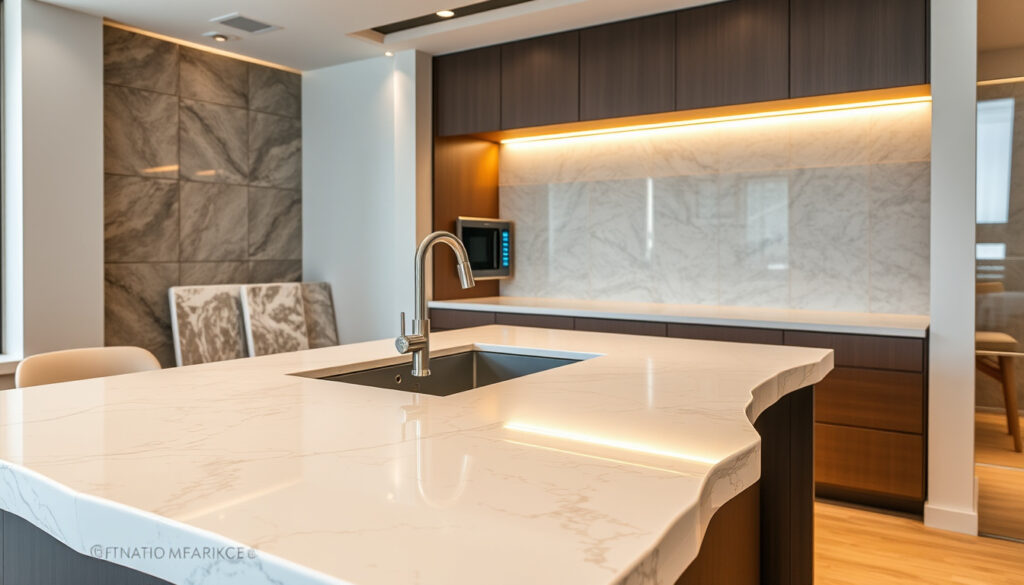
The countertop material now wraps down the sides of the island (waterfall effect) and sinks are seamlessly integrated – no rim to trap grime. This requires precise cutting, adding 10-15% to installation cost.
Bold colours: deep blues, greens, and terrazzo patterns
White marble-look quartz is being pushed aside by moody charcoal, deep navy, and forest green. Terrazzo patterns (speckled composite) are back for accent islands. Ornan Kitchens confirms quartz now comes in dozens of such colours.
Sustainable materials: recycled glass, recycled quartz
Eco-conscious buyers are turning to surfaces made from recycled glass and post-industrial quartz. While still a niche – less than 5% of Irish sales – the range is expanding.
Mixed materials: combining wood with stone
Kitchen islands now often feature a different material than the perimeter – warm wood for the island, cool quartz or granite around the walls. The contrast adds depth.
An Irish homeowner choosing a 2026 countertop isn’t just picking a surface; they’re making a design statement that will define the room. The wrong colour can date the kitchen by 2028.
Which is better Corian or quartz worktops?
Five factors separate these two popular solid-surface options. Here’s the breakdown.
Composition and appearance
- Corian – Acrylic-based solid surface. Seamless joints. Available in 76 colours (The Irish Times). Cannot mimic natural stone perfectly.
- Quartz – Engineered stone (90% quartz particles + resin). Looks more like natural stone. Non-porous and harder.
Durability and heat resistance
Corian withstands up to 90°C; quartz up to 150°C but sudden heat (a pan from the hob) can crack it. The Irish Examiner warns that quartz should be used carefully with hot pots.
Maintenance and repair
Corian can be sanded down to remove scratches. Quartz is harder to repair – scratches typically require whole-slab replacement. Both are non-porous, so no sealing needed.
Cost comparison
Corian starts around €380 per linear metre (The Irish Times). Quartz ranges from €450 to €650 per linear metre (Irish Examiner).
Best use cases
- Corian – Ideal for curved islands, integrated sinks, bright colours, heavy DIY repair needs. Not ideal for high-heat zones.
- Quartz – Best for clean, modern kitchens with standard layouts. Value for money given its durability and stain resistance.
Corian’s softer surface scratches more easily, so families with young children may find quartz the smarter long-term choice despite the higher upfront cost.
The table below puts Quartz, Granite, and Laminate side by side.
| Feature | Quartz | Granite | Laminate |
|---|---|---|---|
| Heat resistance | Up to 150°C (shock sensitive) | Up to 480°C | Up to 120°C (blisters) |
| Maintenance | None (non-porous) | Seal every 1–2 years | Wipe clean only |
| Cost per sq ft (installed) | €50–€100 | €60–€150 | €10–€40 |
| Lifespan | 50+ years | 50+ years | 10–15 years |
What countertops look high-end but cheap?
Budget doesn’t have to mean bare. Several strategies deliver an expensive look without the price tag.
Laminate with realistic stone prints
Modern high-pressure laminate (HPL) can mimic marble or quartz convincingly. The key: choose a slab with thick, eased edges – a 3mm bevel makes all the difference. The Panelling Centre offers laminate worktops starting at under €30 per linear metre.
Butcher block: warm and affordable
Solid wood worktops cost $30–$60 per sq ft installed. They add instant warmth and can be sanded down when scratched. Must be sealed against moisture – especially important in Ireland’s humid climate.
Tile countertops: ceramic or porcelain
Porcelain slabs are extremely durable and can mimic marble at a fraction of the cost. Large-format tiles (60x60cm) minimise grout lines. Cost: €15–€30 per sq ft installed.
Concrete: industrial chic on a budget
Concrete countertops from specialist studios start at €600 per linear metre (The Irish Times). They require sealing and can develop hairline cracks, but that’s part of the look.
Strategies to achieve high-end look: edge profiles, undermount sink
- Choose a bullnose or bevelled edge – adds perceived value
- Undermount sinks create a seamless top (easier to wipe)
- Use matching stone for the backsplash (or a thin slab splashback)
- Avoid speckled patterns – solid colours read as more expensive
Upsides
- Laminate with thick edges can pass for stone at 1/10th the cost
- Butcher block is renewable and characterful
- Concrete offers a custom, industrial look
- Porcelain slabs are extremely durable and low-maintenance
Downsides
- Laminate cannot be refinished – once damaged, replace
- Wood requires annual resealing in damp Irish homes
- Concrete can stain if not sealed correctly
- Tile grout lines can be hard to keep clean
What countertop colors are considered outdated?
Colour trends shift, and Irish kitchens are ditching several once-popular shades. Here’s what to avoid and what to embrace for 2026.
Colors to avoid: beige, almond, golden oak, speckled patterns
- Beige and almond – read as dated (think 1990s builder-grade)
- Golden oak laminate – too yellow
- Speckled patterns (white with gold flecks, dark brown granite with ornate veining) – look busy and cheap
Designer picks: neutral gray, warm whites, deep navy
Matte finishes are in. Off-white and warm gray are the new neutrals. Deep navy and charcoal create a focal point, especially on an island. Ornan Kitchens confirms that quartz colour ranges now prioritise these tones.
How floor color affects countertop choice
Lighter floors (light oak, pale tile) pair well with darker counters for contrast. Dark floors (slate, dark wood) work with white or light gray tops. Consistency works too – if floor and counter share the same colour family (both warm, both cool), the room feels cohesive.
Current color trends for 2026
- Matte finishes over glossy – reduces fingerprints
- Dark greens and deep blues – especially in quartz and sintered stone
- Charcoal and off-white – safe, timeless, easy to sell
- Terrazzo patterns for accent islands – a playful splash
An Irish homeowner with a 2026 budget should avoid beige and speckled granite. Instead, opt for matte charcoal or off-white quartz – both will hold resale value and feel current for the next decade.
worktoplibrary.co.uk, wap.stonecontact.com, work-tops.com, cncrouter.ie, reddit.com, premiergranitetops.com, getlocal.ie
For a closer look at the latest styles and price points, refer to our coverage of 2026 kitchen countertop trends that highlight the best materials for Irish homes.
Frequently asked questions
Can you put a hot pan directly on quartz countertops?
No. Quartz is engineered with resin that can soften or crack under sudden high heat. According to the Irish Examiner, quartz should be used carefully with hot pots. Always use a trivet.
How do I remove stains from granite?
Blot (don’t rub) with a mild soap and water. For oil-based stains, apply a baking soda paste and cover for 24 hours. Seal your granite every 1–2 years to prevent future stains.
What is the best countertop for a kitchen island?
Quartz or granite for durability, butcher block for a warm contrast. If the island is used for prep, choose non-porous quartz for hygiene.
Are sealed wood countertops sanitary?
Yes, if properly sealed with food-safe oil or varnish. Wood has natural antibacterial properties. Wipe spills promptly and reseal every 6–12 months.
How long does it take to install kitchen countertops?
Once ordered, installation typically takes 2–5 days for a standard kitchen. Laminate can be done in 1–2 days; stone or sintered stone requires 3–5 days for templating and cutting.
What is the most eco-friendly countertop material?
Recycled glass and recycled quartz are the most sustainable. Butcher block (from sustainably harvested wood) and concrete (made locally) also score well.
Can you put a hot cup of tea on quartz?
- Generally yes – normal cup temperatures (60–75°C) are safe. But sudden heat from a pan straight from the hob is risky.
What’s confirmed and what’s unclear
Confirmed facts
- Quartz is non-porous – confirmed by manufacturers (Ornan Kitchens)
- Granite heat resistant up to 480°C
- Laminate is cheapest countertop material
- Corian can be repaired with sanding (The Irish Times)
- Dekton is zero-porosity and heat/stain/scratch-proof (The Irish Times)
What’s unclear
- Long-term durability of sintered stone compared to quartz in high-use Irish homes
- Effect of Irish damp climate on engineered stone expansion over decades
- Exact market share of each material – estimates rely on fabricator surveys
- Real-world performance of recycled quartz after 10+ years
“Quartz from Silestone is a good top that should last for many years if used carefully with hot pots.”
– Spokesperson, Irish Examiner (home & gardens)
“Quartz remains a popular choice with Irish homeowners thanks to its selection of colours and styles.”
– Spokesperson, Ornan Kitchens
“A high-end look on a budget is achievable with laminate that has thick, eased edges – the edge profile makes the difference.”
– Spokesperson, The Panelling Centre
For an Irish homeowner planning a 2026 renovation, the choice is clear: invest in a durable, low-maintenance surface like quartz or granite for the main kitchen, and use a contrasting material on the island to add character. Avoid beige and speckled patterns. Budget-conscious? Laminate with a smart edge profile or butcher block will deliver the look without breaking the bank.
More related posts
 Daniel Cormier: UFC Record, Accusations & Tragedy
 Ludivine Reding: Biography, Age, Movies & Instagram
 Run for the Cure 2026: Dates, 5K Details & Locations
 How Long Does Implantation Bleeding Last? Duration & Signs
 Death Becomes Her Musical – Broadway Run, Cast, Tickets
 Cast of Law & Order Organized Crime – Season 5 Cast and Changes
 Variety Store Near Me: What They Sell & How They Compare Online
 Taylor Rooks: Relationship, Career, Net Worth, Age & More
